Have you ever used a phone to call someone? If so, you have already used a network very similar to the Fediverse.
Phone calls work seamlessly because all the hundreds of different phone providers in the world are connected together. From the user’s point of view it’s as if all phones in the world are on the same network, even though in reality they are hundreds of independent networks that talk to each other.
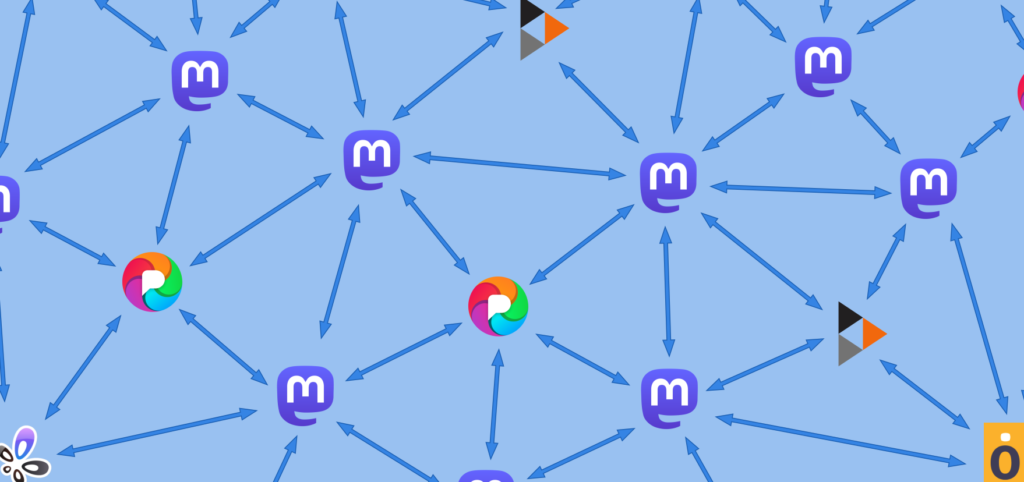
The Fediverse is the same idea but for social media. The Fediverse is a collection of thousands of independent social media servers that talk to each other seamlessly. This means that the millions of users on these servers can interact with each other as if they were on a single social network.
The most popular and famous type of Fediverse server at the moment is called Mastodon and works a bit like a calmer friendlier version of Twitter, but there are many kinds of Fediverse servers including video platforms, book groups, community calendars etc. The Fediverse is made up of thousands servers, all of which are fully independent but talk to each other to form a single social network.
The process of interacting with other servers on the Fediverse is so seamless, most people don’t even notice that they are communicating with other servers. This is the same experience that people have with phone calls, where they have no idea they are talking to someone on another provider.
I’m still a bit lost. Is there anywhere I can get more info for beginners about the Fediverse?
Yes! These videos may help:
- Mastodon in 180 seconds ⧉
- What is Mastodon? ⧉
- Introducing the Fediverse ⧉
- Crafter’s guide to the Fediverse ⧉ (not just for crafters!)
- What is the Fediverse? ⧉
Most of the information in the videos specifically about Mastodon applies to the rest of the Fediverse too.
Wait a minute. If different kinds of servers can talk to each other, how do they interact? What do people see on their timeline?
Let’s suppose someone has an account on a Mastodon server. They can use this account to follow other people from other Mastodon servers but they can also follow accounts from completely different kinds of Fediverse servers too.
For example, if they follow a video account from PeerTube, videos from the PeerTube account will start appearing in their Mastodon timeline just like Mastodon posts do. If they reply to one of these video posts within their timeline on Mastodon, that reply will also appear as a comment below that video on PeerTube.
There are many other kinds of server on the Fediverse, such as Pixelfed for photos, BookWyrm for reviewing books, WordPress for writing blogs etc. All of them can be followed and interacted with from Mastodon accounts.
I thought the Fediverse and Mastodon were the same thing? Where does the word “Fediverse” come from?
Mastodon is currently the most popular kind of Fediverse server, but it’s just one kind. There are many other kinds, communicating through a common standard to form a single network. The collective term for this network of compatible servers is “The Fediverse”, which is short for “Federated Universe”.
Who owns Mastodon? Who owns the Fediverse?
No one owns Mastodon or the Fediverse, each server is totally independently owned by whoever set it up. Ownership of the network is spread across thousands of independent server owners.
Why is the Fediverse like this? Why is it spread out on so many servers?
There are lots of important reasons for the Fediverse being spread out like this.
I saw an interview with the CEO of Mastodon. Surely that means someone owns it?
There is a German organisation called Mastodon gGmbH that develops the free open source software which most Mastodon servers use. However, they do not have any ownership or control over the servers that use their software.
The person who is often credited as “the head of Mastodon” is actually just the person in charge of developing its free open server software. They don’t own or control the network in any way.